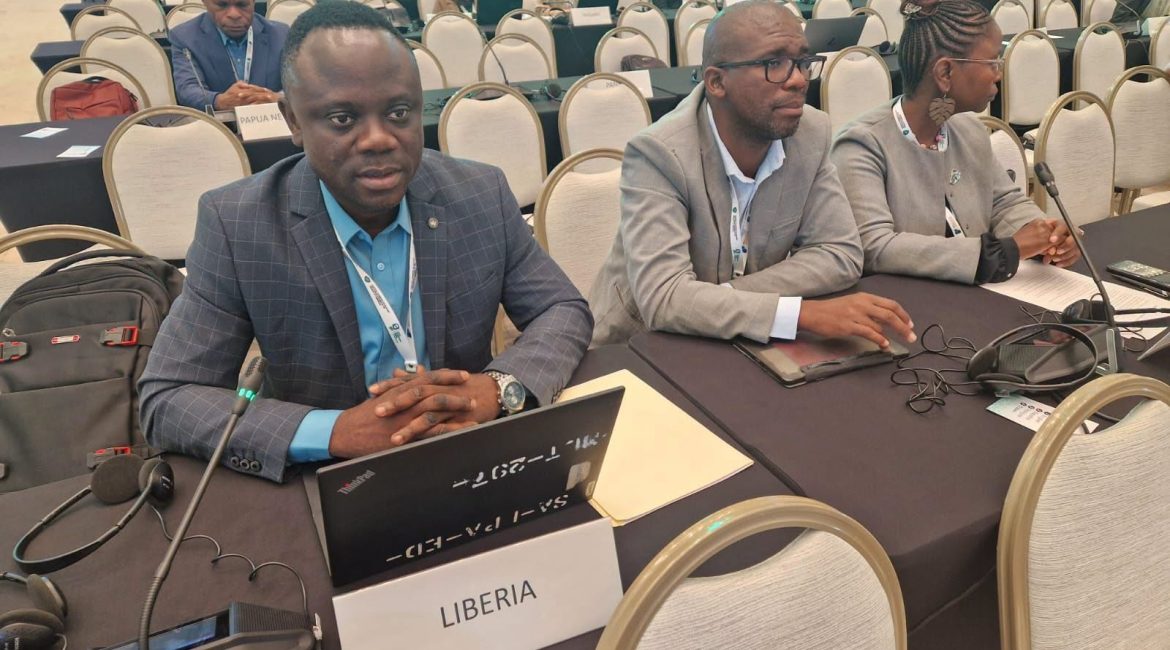

Samarkand, Uzbekistan, June 6, 2026 – The Government of Liberia through the Environmental Protection Agency (EPA) of Liberia has welcomed key decisions taken at the 71st Global Environment Facility (GEF) Council meeting in Samarkand, describing them as a significant boost to international environmental finance and global climate action through 2030.
The Council concluded with the approval of $232.5 million in new financing for 24 projects and programs across 22 countries, alongside the endorsement of programming directions for the $3.9 billion GEF-9 replenishment cycle, marking a major step forward in global environmental investment.
According to the GEF, the decisions effectively launch a “final sprint” toward achieving international environmental goals by 2030, particularly in the areas of climate change, biodiversity conservation, land degradation, chemicals management, and ecosystem protection.
Liberia’s national statement at the Assembly and Council meetings was delivered by Mr. Desmond T. Thompson, Alternative GEF Operational Focal Point, on behalf of EPA Executive Director Dr. Emmanuel King Urey Yarkpawolo, who also serves as Liberia’s Operational Focal Point to the GEF.
In the statement, Thompson welcomed the opportunity for Liberia to participate in the high-level discussions and expressed appreciation to the Government and people of Uzbekistan for their hospitality in hosting the meetings in the historic city of Samarkand.
He underscored that the world is facing interconnected environmental crises, including climate change, biodiversity loss, land degradation, pollution, and deforestation, which are increasingly affecting food security, public health, water systems, and livelihoods, especially in vulnerable developing countries.
Mr. Thompson emphasized that Liberia, despite its significant contribution to global biodiversity through its forest resources, is highly exposed to climate risks such as sea-level rise, coastal erosion, flooding, and extreme weather events.
He stressed that while GEF-supported interventions in Liberia have contributed to coastal protection, climate-resilient agriculture, biodiversity conservation, and environmental data systems, the scale of environmental challenges continues to exceed available financing.
The EPA Project Liaison Officer therefore called for increased, predictable, and accessible funding to support developing countries in implementing their Nationally Determined Contributions, National Adaptation Plans, and commitments under the Kunming-Montreal Global Biodiversity Framework.
He further urged development partners to demonstrate greater ambition during the upcoming GEF-9 replenishment cycle, including stronger support for the Least Developed Countries Fund and other targeted financing windows.
Liberia also reaffirmed its commitment to strengthening environmental governance under the leadership of President Joseph Nyuma Boakai Sr., noting the recent reconstitution of its GEF National Committee to enhance coordination, transparency, and accountability in project implementation.
The EPA reaffirmed Liberia’s readiness to work with the GEF partnership, donor countries, and international stakeholders to advance shared global environmental goals.
The 71st GEF Council decisions, combined with the GEF-9 programming direction, are expected to shape international environmental financing and implementation strategies through 2030, strengthening global efforts to address the climate and biodiversity crisis.
The Global Environment Facility remains one of the world’s largest multilateral environmental funding mechanisms supporting developing countries in addressing climate change, biodiversity loss, land degradation, and pollution.
Liberia Welcomes Landmark GEF Decisions as Global Council Approves $232.5 Million in New Environmental Financing