
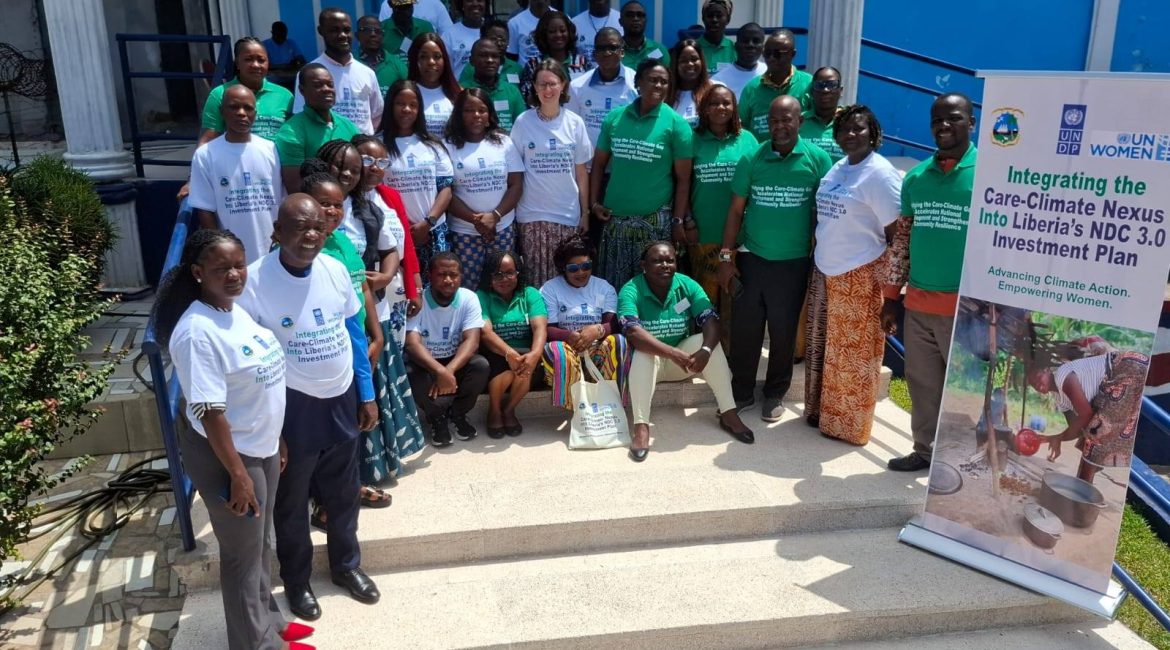
Buchanan, Grand Bassa County – March 4, 2026 – The Environmental Protection Agency of Liberia, in partnership with UN Women, United Nations Development Programme, and the Ministry of Gender, Children and Social Protection, today launched a two-day National Policy Dialogue aimed at linking the care economy with climate action under Liberia’s Revised Nationally Determined Contribution (NDC 3.0).
The event brought together about 59 participants from government ministries and agencies, civil society organizations, youth groups, rural women groups, private sector institutions, development partners, and the media.
The dialogue focuses on how climate change is increasing unpaid care work, especially for women and girls, and how national climate investments can reduce that burden while promoting economic growth.
Liberia’s NDC 3.0 aims to reduce greenhouse gas emissions by 64 percent by 2035. It also plans to allocate 20 percent of climate finance to women-led groups and smallholder farmers. Participants discussed how climate investments such as solar-powered water systems, clean cooking solutions, climate-smart agriculture, and community care centers can reduce care work and support economic growth at the same time.
Representing EPA Executive Director Dr. Emmanuel K. Urey Yarkpawolo, Mr. Benjamin Karmohn, Chief Technical Advisor to the Executive Director, thanked partners and participants for supporting the initiative.
He described climate change as a serious national concern that requires strong and inclusive action. According to him, Liberia’s NDC 3.0 sets a target to reduce greenhouse gas emissions by 64 percent by 2035, but the success of the plan depends on how well it includes women, youth, and vulnerable communities.
He stressed that climate policies must address the daily realities of Liberian families. He noted that flooding, drought, and environmental degradation are increasing the work women and girls do at home, especially in collecting water, gathering firewood, and caring for children and the elderly.
“Climate change is not just about emissions. It is about people and how they live,” he said. “If our climate investments do not reduce the burden on women and families, then we are not fully solving the problem.”
Mr. Karmohn urged participants to use the dialogue to produce clear policy recommendations and practical steps that will guide the integration of care priorities into the NDC 3.0 Investment Plan.
Yemi Falayajo, Deputy Country Representative of UN Women, thanked the Government of Liberia for creating space for such an important discussion.
She explained that women already carry a heavy burden of unpaid care work, and climate change is making the situation worse. She pointed out that when communities face floods or drought, it is often women and girls who walk longer distances for water and firewood or stay home to care for sick family members.
“Investing in care systems is not a cost, it is an investment in our economy,” she said. “When women spend less time on unpaid work, they have more time for education, business, and leadership.”
She encouraged participants to focus on practical solutions such as solar-powered water systems, clean cooking technologies, climate-smart agriculture, and community care centers. According to her, these solutions can reduce women’s time poverty while also supporting climate goals.
Representing the British Embassy near Monrovia, Deputy British Ambassador Madam Joanna Markbreiter reaffirmed the United Kingdom’s support to Liberia’s climate and gender priorities.
She stressed that climate action must be fair and inclusive. She noted that women and vulnerable groups are often the most affected by climate change but receive the least support.
“Climate finance must reach the people who need it most,” she said. “Strong partnerships and accountability will ensure that resources bring real change in communities.”
She praised Liberia for taking steps to integrate gender into its climate plans and encouraged continued collaboration among government, partners, and civil society.
Atty. Salimatu Gilayeneh, representing the United Nations Development Programme, highlighted Liberia’s commitment under NDC 3.0.
She said integrating care into the NDC Investment Plan will make climate action stronger and more effective. According to her, climate policies that consider social issues such as unpaid care work are more realistic and impactful.
“We must design policies that respond to the real challenges people face every day,” she said. “Clear recommendations and actions from this dialogue will help move from discussion to implementation.”
Hon. Curtis V. Dorley, Deputy Minister for Research, Policy and Planning at the Ministry of Gender, Children and Social Protection, delivered remarks on behalf of Minister Gbeme Horace Kollie.
He thanked the EPA for always ensuring that gender issues are included in national programs. He said the workshop is very important because climate change and environmental degradation are increasing women’s and girls’ unpaid care and domestic work.
He reminded participants that the climate crisis does not affect everyone equally. According to him, women and girls are highly dependent on natural resources for food, water, and firewood, making them more vulnerable to climate shocks.
“Climate policy that ignores gender equality is not only unjust, it is ineffective,” Hon. Dorley said. “Women and girls are on the frontlines of climate change and must be part of the solutions.”
He also repeated recommendations he made during the NDC 3.0 development process in 2025. These include introducing climate change education into school curriculum at all levels, providing scholarships for women and girls in natural resource management, offering economic empowerment training for rural and urban women, and creating specialized training opportunities for persons with disabilities, including albino groups.
He further called for better access to climate information in local languages and stronger gender-responsive social protection systems.
Encouraging open participation, he told attendees, “Speak now or forever hold your peace. This is the time to shape policies that will affect our people.”
Representing Grand Bassa County Superintendent Karyou Johnson, Mr. Zuu Menyon welcomed participants to Buchanan and thanked the organizers for selecting the county to host the dialogue.
He said Grand Bassa, as one of Liberia’s historic counties, is ready to support national climate efforts. He noted that climate change is already affecting communities in the county, especially coastal areas where flooding and erosion are serious concerns.
“Our people are feeling the impact,” he said. “We must work together to ensure that the decisions made here bring real benefits to women, youth, and families.”
The dialogue continues as stakeholders seek to strengthen Liberia’s climate response while promoting gender equality and building an inclusive green economy.
