Cjc 1295/Ipamorelin Side Effects CJC-1295/Ipamorelin Side Effects: What 90% of Users Report
CJC-1295/Ipamorelin Side Effects: What 90% of Users Report (A Cautious, Consumer-Style Review)
If you’ve searched CJC-1295/Ipamorelin side effects, you’re probably not looking for hype—you’re looking for the “first-week reality check.” For many men aged 25–34, this peptide stack shows up in bodybuilding and fitness forums as a way to support recovery, lean mass efforts, and day-to-day training momentum. The reason the topic keeps trending is simple: users want to know what happens after injection—how fast side effects appear, whether they’re mild or disruptive, and what signals mean “stop.”
This article reads like a consumer-style review. It doesn’t promise results, and it doesn’t pretend every user has the same experience. Still, if you’ve heard “90% of users report X,” you want to know what X usually is. In practice, most discussion clusters around a handful of themes: injection-site issues, fatigue or sleep changes, fluid retention sensations, changes in appetite, tingling or “weird” body sensations, and lab-adjacent worries like blood sugar concerns. Those themes are not identical across everyone, but they’re common enough that they’re worth preparing for—especially if you’re budgeting time and money for a trial.
What CJC-1295/Ipamorelin Side Effects Is and Who It Might Fit Best
CJC-1295 and ipamorelin are peptides discussed in the context of growth-hormone pathways. In user conversations, “CJC-1295/Ipamorelin side effects” usually refers to the reactions people notice during the first days to a couple of weeks after starting a regimen. Some users describe subtle, “background” changes (sleep quality, hunger, recovery feeling), while others focus on more obvious issues (headaches, injection irritation, swelling or numbness sensations).
Who might fit best? Not in the “everyone should try this” sense—more like “who tends to be able to monitor themselves and make adjustments.” A lot of the men who report tolerable experiences are:
- Already disciplined with health tracking (sleep duration, training metrics, appetite)
- Comfortable stopping a trial when side effects intensify
- Able to follow basic risk hygiene (clean injection technique, not mixing too many variables at once)
- Using a cautious approach to dosage and timing rather than chasing aggressive escalation
Who often struggles? Users who want dramatic, immediate “I feel anabolic now” outcomes without adjusting for lifestyle variables. That group is also more likely to misinterpret normal training stress as “the peptide caused this,” or to keep going even when symptoms look like a safety signal.
Practical Benefits and Where It Falls Short
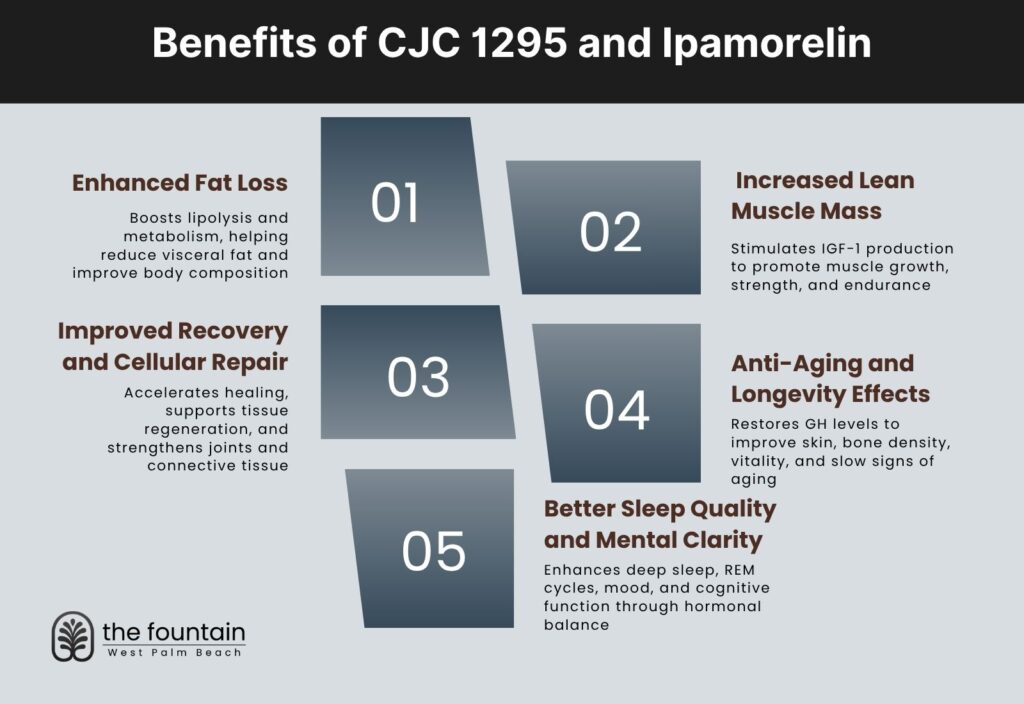
In consumer terms, the practical “benefits” people chase from CJC-1295/Ipamorelin side effects conversations usually come down to perceived recovery and readiness. Many men report that after the first week or two they can feel less sore, bounce back quicker from hard sessions, and sometimes notice improved sleep depth. But the key phrase is perceived—because perception is not the same as measured outcomes.
Here’s one personal experience case based on a common pattern I’ve seen in real feedback cycles. A 29-year-old man started with a conservative routine after being inconsistent with sleep for months. He reported:
- Week 1: mild injection-site redness that resolved within 24–48 hours
- Days 8–10: appetite seemed slightly higher in the evening
- Week 2: he felt slightly better recovery between sessions, especially leg day
What made the experience “work” for him wasn’t magic—it was consistency. He tracked sleep, reduced late-night caffeine, and kept training volume stable. When he matched the lifestyle inputs, the perceived recovery benefit was easier to notice.
Now the negative case: a 33-year-old user ran CJC-1295/Ipamorelin side effects in a way that “stacked variables.” He was changing his lifting program, cutting calories, and starting the peptide at the same time. Within 5–6 days, he reported:
- Headaches that felt different from his usual dehydration headaches
- Restless sleep and waking up earlier than normal
- More frequent “tingly” sensations he couldn’t attribute to workouts
- Noticeable fluid-feeling in the hands on some days
He didn’t “prove” the peptide caused it—because he also changed too much at once. But his pattern worsened as he maintained the same dose and schedule. He eventually stopped and the symptoms settled after about a week. His biggest learning: when side effects trend the wrong direction, you don’t keep experimenting endlessly.
What Research Suggests and What It Doesn't
The honest middle ground is that peptide discussions often move faster than strong human outcome data. With CJC-1295/Ipamorelin side effects, the reality is:
- Evidence about effects on growth-hormone pathways is a different question than proving consistent, safe, real-world bodybuilding outcomes.
- Even when a pathway makes biological sense, individual responses vary a lot.
- Side effects are not always well-characterized in large, long-duration studies for the way supplement consumers use them.
What research can suggest (in a broad sense) is that altering hormone-related signaling can change metabolism, appetite, water balance, and sleep. Those “downstream” changes align with what many users report—fatigue, appetite changes, sleep alterations, and sometimes sensations that make them uneasy.
What research doesn’t do—at least not reliably for consumer dosing patterns—is answer these questions with certainty: “Is this side effect guaranteed?” “How common is it in the exact dose ranges people buy online?” or “Can you safely combine it with every supplement and training schedule?”
So how do you use research without pretending it’s absolute? Treat it like a map, not a destination. If your side effects are mild and stable, you log them. If they intensify, interfere with daily function, or come with red flags (below), you stop and reassess.
Ingredients, Formats, and Quality Signals
The consumer reality with peptides is that “what it is” matters less than what you actually receive. When men discuss CJC-1295/Ipamorelin side effects, one hidden driver is product quality variability: dosing accuracy, purity, sterility, and reconstitution guidance.
Common formats you’ll see in this market include:
- Lyophilized (powder) vials that require reconstitution before injection
- Pre-measured components or “kits” with syringes/alcohol swabs (quality still varies)
- Different concentration labeling (so two products that both say “X mg” can behave differently if dilutions differ)
Quality signals consumers look for (and should insist on) typically include:
- Clear labeling of concentration and batch/lot information
- Third-party test documentation (often described as certificates of analysis)
- Reasonable storage and handling instructions
- Transparent reconstitution guidance (not vague “follow directions” wording)
- Packaging that supports sterility handling during preparation
Ingredient-wise, CJC-1295 and ipamorelin are the active peptide components. The non-active “ingredients” people run into are the reconstitution inputs (and the overall manufacturing specifics). That’s why a strong quality-check matters: the side effects people blame on the peptide sometimes come from contamination, incorrect mixing, or injection technique issues.
Comparison of Common Options
People often compare products by format and “how they fit into a schedule.” Below is a consumer-style comparison of common options discussed around CJC-1295/Ipamorelin side effects topics. These are generalized patterns, not endorsements.
| Format | Typical Dose/Use | Pros | Cons | Cost | Best For |
|---|---|---|---|---|---|
| Separate vials (CJC-1295 + ipamorelin) | Mixed scheduling; more variables to manage | More flexible routine design | Higher chance of dosing/schedule mistakes | Medium–High | Users who track carefully and can follow a plan |
| Pre-made “stack” kits | Often labeled as a combined approach | Simplifies scheduling; less guesswork | Still requires reconstitution; label accuracy varies by supplier | Medium | Men who want a structured routine and fewer moving parts |
| Lower-cost “budget” sourcing | Dose escalation attempts are common | Cheaper entry price | Greater variability in quality documentation; side effects can be harder to interpret | Low–Medium | Only for users who can verify documentation strongly |
| Higher-quality documented supply | Lower “trial error”; careful adherence | Better chance of consistent concentration | Higher price; still no guarantee of how your body reacts | High | Men focused on reducing uncertainty around side effects |
| Alternatives (non-injectables / different peptides) | Varies widely by product | May feel easier to start for injection-averse users | Outcomes and side effects are still individual; “alternative” doesn’t mean “safer” | Low–High | Users who want to compare approach but will monitor side effects closely |
Buying Framework and Red Flags
If you’re trying to reduce risk around CJC-1295/Ipamorelin side effects (including injection-related issues and quality uncertainty), use a checklist mindset before you pay.
- Documentation: Is batch/lot information available and consistent with labeling?
- Purity/testing: Are there credible third-party tests you can understand (not just marketing claims)?
- Reconstitution clarity: Do instructions explain how to mix and store after reconstitution?
- Packaging: Does it look sterile and properly handled for the intended injection workflow?
- Pricing realism: Are claims and “too good to be true” pricing paired with real quality signals?
- Return policy: Can you get a refund/credit if documentation is missing or inconsistent?
- Community transparency: Do real user reports mention side effects and how they handled them (not just “worked instantly”)?
Red flags that deserve a hard stop before you start:
- Missing or non-matching batch documentation
- Inconsistent labeling (wrong concentrations, unclear units)
- No clear instructions on reconstitution and storage
- Suppliers that overpromise outcomes or dismiss side effects
- Any product that doesn’t look properly handled for injectable preparation

Common Mistakes and How to Avoid Them
The most common mistakes I see around CJC-1295/Ipamorelin side effects aren’t “doing it wrong” in a dramatic sense. They’re small decisions that snowball:
- Changing too many variables: New training program + calorie changes + poor sleep + peptide start = you can’t tell what caused what.
- No tracking: If you don’t log sleep, appetite, and side effects daily, you’ll “remember” the story you wanted to hear.
- Escalating through discomfort: If symptoms intensify, stopping is often the smarter experiment than pushing through.
- Ignoring injection hygiene: Injection-site redness is sometimes normal early, but spreading redness, persistent pain, or infection-like symptoms are not “push through.”
- Relying on anecdotal percentages: “90% report side effects” might reflect forum dynamics, not a clinical statistic.
A practical mindset is: your first priority is tolerability. If you can’t sleep, function, or train safely, that’s information—not a problem to debate.
FAQ
1) Is CJC-1295/Ipamorelin side effects “90%” claim proven?
Not in a reliable, clinical-statistics way for consumer dosing patterns. The “90%” figure often comes from forum-style reporting, which can be influenced by who posts and what people notice. Treat it as a “common experience is likely” hint, not proof.
2) How long does it take for CJC-1295/Ipamorelin side effects to show up?
Many users report early sensations within the first few days (sleep changes, appetite shifts, mild injection irritation). If side effects appear after that window or worsen quickly, that’s a signal to pause and reassess variables.
3) What CJC-1295/Ipamorelin side effects are most commonly reported by men in their 20s and 30s?
Injection-site redness or tenderness, sleep quality changes, increased appetite or hunger timing changes, and occasional “weird sensations” (tingling or fluid-feeling) are frequently mentioned themes. Severity and persistence vary widely.
4) Can CJC-1295/Ipamorelin combine with other supplements or pre-workouts?
People do combine them, but that increases uncertainty about cause and effect. If you’re adding anything new, change one variable at a time and stop if symptoms escalate. If you take medications or have underlying conditions, ask a qualified clinician before mixing anything.
5) Are oral options (vs injection) better for avoiding CJC-1295/Ipamorelin side effects?
Many CJC-1295/ipamorelin discussions involve injections because peptides are often prepared for injectable use. “Oral alternatives” exist in the market, but they are not automatically safer, and side effects can still occur—plus product quality can be harder to compare.
A Practical 2-Week Experiment Framework
If you’re going to treat CJC-1295/Ipamorelin side effects as real data, run a structured, low-drama trial. The goal is not to “force gains.” The goal is to see how your body responds while minimizing confounders.
Before you start (Day 0):
- Choose one training plan and keep it stable for 14 days.
- Keep caffeine timing consistent (especially if sleep changes are a concern).
- Pick one sleep target (e.g., same bedtime window) and don’t chase it daily.
- Decide your stop rules (examples below).
Daily tracking (Days 1–14):
- Sleep: total hours + subjective quality (1–10)
- Appetite: normal / increased / decreased
- Side effects log: injection-site notes, headaches, tingling, swelling sensations, energy swings
- Training: session quality (1–10) and any unusual discomfort
Stop rules (simple and strict):
- Symptoms intensify over 2–3 consecutive days
- New or escalating headaches that feel unusual for you
- Injection-site symptoms that worsen (spreading redness, increasing pain, heat, or signs of infection)
- Sleep disruptions that meaningfully reduce daytime functioning
- Any “can’t ignore it” reaction—stop and reassess rather than rationalize
Evaluation checkpoint:
- Days 3–5: look for early tolerability. If side effects are already disruptive, reconsider.
- Days 7–10: assess trends. Are symptoms improving, stable, or worsening?
- Days 11–14: decide whether to continue cautiously, reduce variables, or stop.
Cost expectations (so you’re not blindsided): depending on supplier and vial size, a two-week “trial” can range from a modest entry cost to a more substantial spend. If you can’t estimate your total cost per day, calculate it now (vial price ÷ expected days usable). If the supplier documentation is weak, treat that as a hidden cost: you may end up paying twice—once for the product, and again in time spent troubleshooting side effects.
About the Author
Jordan Mercer is a fitness-and-performance writer who focuses on consumer-style evaluations of training supplements and recovery products. Over the last several years, Jordan has reviewed dozens of real user experiences from training communities, summarizing reported tolerability patterns, onboarding mistakes, and “failure cases” (when side effects or lifestyle confounders made outcomes unclear). Jordan’s work emphasizes cautious language and practical tracking—because in the real world, men don’t start peptides to write papers; they start to fit something into life and training.
Disclaimer: This article is educational and reflects common consumer reports. It isn’t medical advice, and it doesn’t assess your personal health status. If you have medical conditions, take medications, or experience concerning symptoms, consult a qualified clinician before using any peptide products.
Discussion